The audit came back clean, so the team feels ready to launch. But an audit checks a slice of your code at one moment. Security is a property of the whole system over time. Treating "audited" as "safe" is how protocols get drained after a passing report.
A clean audit report is a real milestone, and it is also one of the most misread documents in crypto. It gets framed as a stamp of safety, printed in the pitch deck, and treated as proof that the system is secure. Then funds move after launch, and the post-mortem shows the exploit was never in scope for the audit at all.
The gap is simple to state. An audit looks at specific code at a point in time. A live protocol is code plus economics, dependencies, keys, upgrades, operations, and everything that changes after the report is signed. This article walks through what an audit does and does not cover, and what actually makes a system safer.
What an audit actually checks
A smart contract audit is a focused review of your contract code against known vulnerability classes: reentrancy, access control mistakes, integer issues, unchecked calls, and similar bugs. A good audit is genuinely valuable, and skipping it is reckless.
But it is bounded by design:
- it reviews specific contracts, not the entire system around them;
- it reflects a point in time, the version handed to the auditors;
- it targets known bug classes, not every way value can leave the system.
A clean smart contract audit means "we did not find these known bugs in this code." It does not mean "this system is safe."
What an audit does not cover
This is where launches go wrong. The most damaging risks usually sit outside the audit scope.
- Economic and market risk. Code can be perfectly correct while the incentives are exploitable. Oracle manipulation, MEV, liquidity attacks, and broken tokenomics drain systems whose contracts passed audit.
- External dependencies. Safe code that calls an unsafe oracle, bridge, or third-party contract inherits that risk. The audit rarely covers what your system depends on.
- Admin keys and privileged access. An audit checks the contract, not who holds the keys, how they are stored, or what those keys can do in one transaction.
- Upgradeability and governance. A proxy or an upgrade can change the contract after the audit. The version users trust may no longer be the version running.
- Operations and incident response. An audit does not give you monitoring, alerting, or a plan for the moment something goes wrong.
- Whatever changed after the report. New features, a redeploy, a config change, a last-minute fix. The audited code and the deployed code are often not the same.
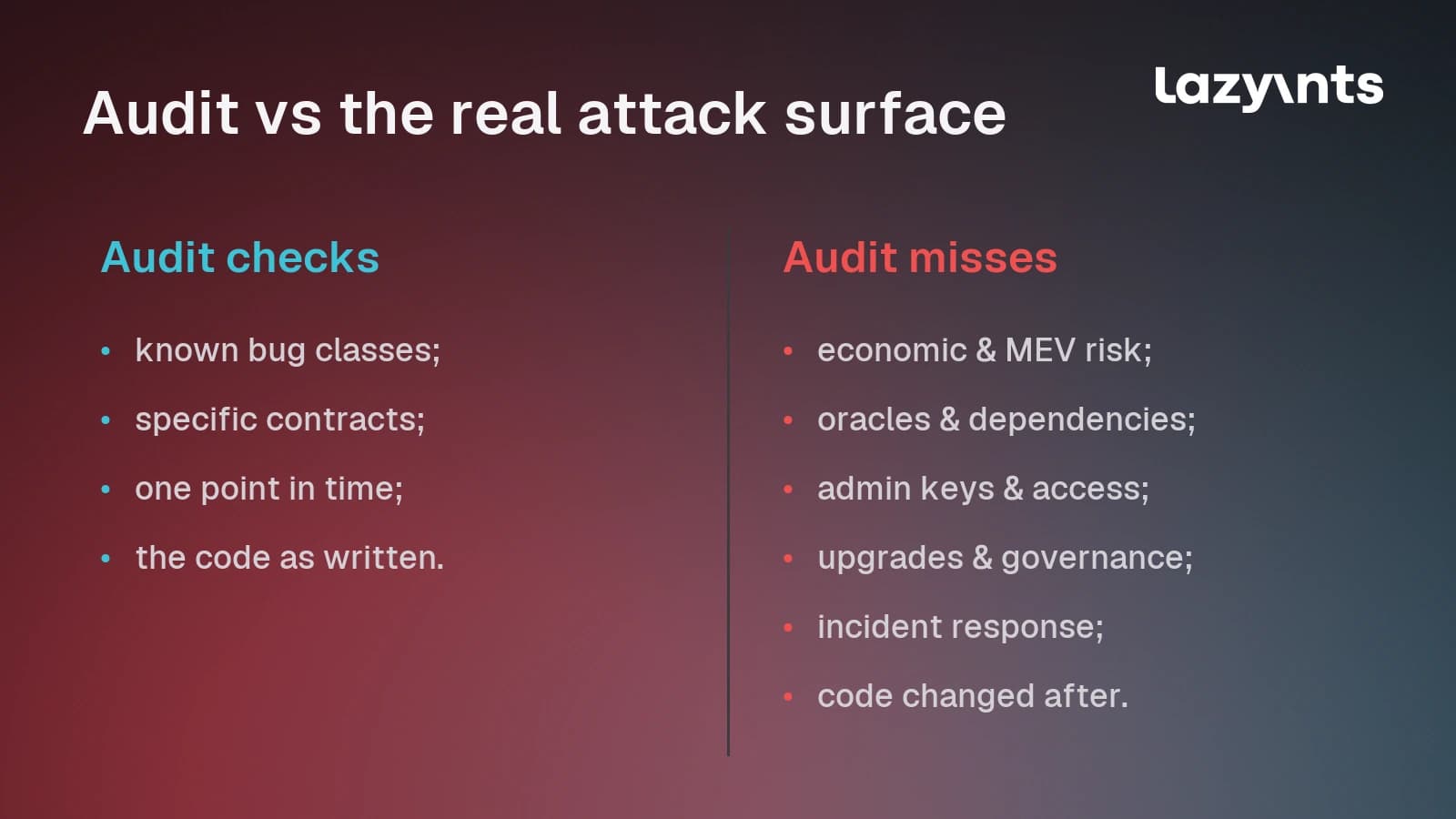
An audit answers "is this code free of known bugs?" Attackers ask a different question: "how can value leave this system?" Those two questions rarely have the same scope.
Why "audited" gets misused
The word "audited" is easy to weaponize for trust. It becomes a badge, a marketing line, a reason to skip harder questions about keys, economics, and operations. A point-in-time snapshot quietly turns into a permanent guarantee in everyone's mind, including the team's.
That false confidence is the actual danger. A team that believes "audited" means "safe" stops looking for the risks the audit never examined.
Security is a property of the whole system, over time
Real safety comes from treating the whole system as the attack surface, and treating security as ongoing work rather than a one-time gate. What actually moves the needle:
- threat-model the full system, including economics, dependencies, and keys, not just the code;
- secure admin keys and define who can intervene, how, and with what limits;
- monitor on-chain activity and alert on abnormal behavior in real time;
- have an incident response plan with someone who can act fast under pressure;
- analyze economic and market risk, including oracles, liquidity, and MEV;
- re-review after every change, because new code is unaudited code;
- design for degraded mode, so a failure can be contained instead of cascading.
Before you treat the system as launch-ready
Ask these before you rely on "audited":
- What was in scope, and what was not? Read the audit's own boundaries.
- Is the deployed code the audited code? Confirm nothing changed after sign-off.
- Who holds the keys, and what can they do? Map privileged access and its limits.
- What does the system depend on? List oracles, bridges, and third-party contracts.
- Is the economic design safe under stress? Model unlocks, liquidity, and manipulation.
- What happens when it fails? Confirm monitoring, alerting, and an incident plan exist.
If you cannot answer these, the audit has given you less certainty than you think.
Conclusions
An audit is a valuable check on your code, and it is only one part of security. A clean report tells you that a specific version of your contracts was free of known bugs at one moment. It says nothing about your economics, your dependencies, your keys, your upgrades, or what happens after launch.
Safe systems come from treating security as a property of the whole system over time: threat modeling, key management, monitoring, incident response, economic analysis, and re-review after every change. Get the audit. Then keep going, because the audit was the start of security work, not the end of it.