
The measurements
Profiles the templates, the server side and the checkout paths, then writes the fix list and prices it.





The store is slow, and nobody can say what it costs or what fixing it takes:
Page speed and Core Web Vitals are costing conversion, and nobody can say which fixes pay back first.
Core Web Vitals are failing in Search Console on the templates that bring organic traffic.
The store got slower after a release or a new app, and nobody can point to the change.
A sale or a peak season is coming, and the store slowed down under the last one.
Someone proposes a new platform to fix speed, and you want to know whether the current one can be fixed first.
If the platform itself is the question, start with the eCommerce Architecture Review instead.
The real failure mode
A lab score measures one page on one connection. Revenue runs through three places it does not see:
Queries and data access on category and search pages, once the full catalog and real filters are loaded.
Caches that clear too often, or never, so the store either serves nothing from cache under load or serves stale prices.
Payment callbacks and third-party calls that stall the path that carries money.
Each of these is cheap to fix once it is found and expensive to find during a sale weekend, when every slow second is lost orders.
Finding them takes access to the running store and its real data, which is most of what the week is spent on.
Two pages from it. The structure is what every audit produces; the figures here are illustrative.
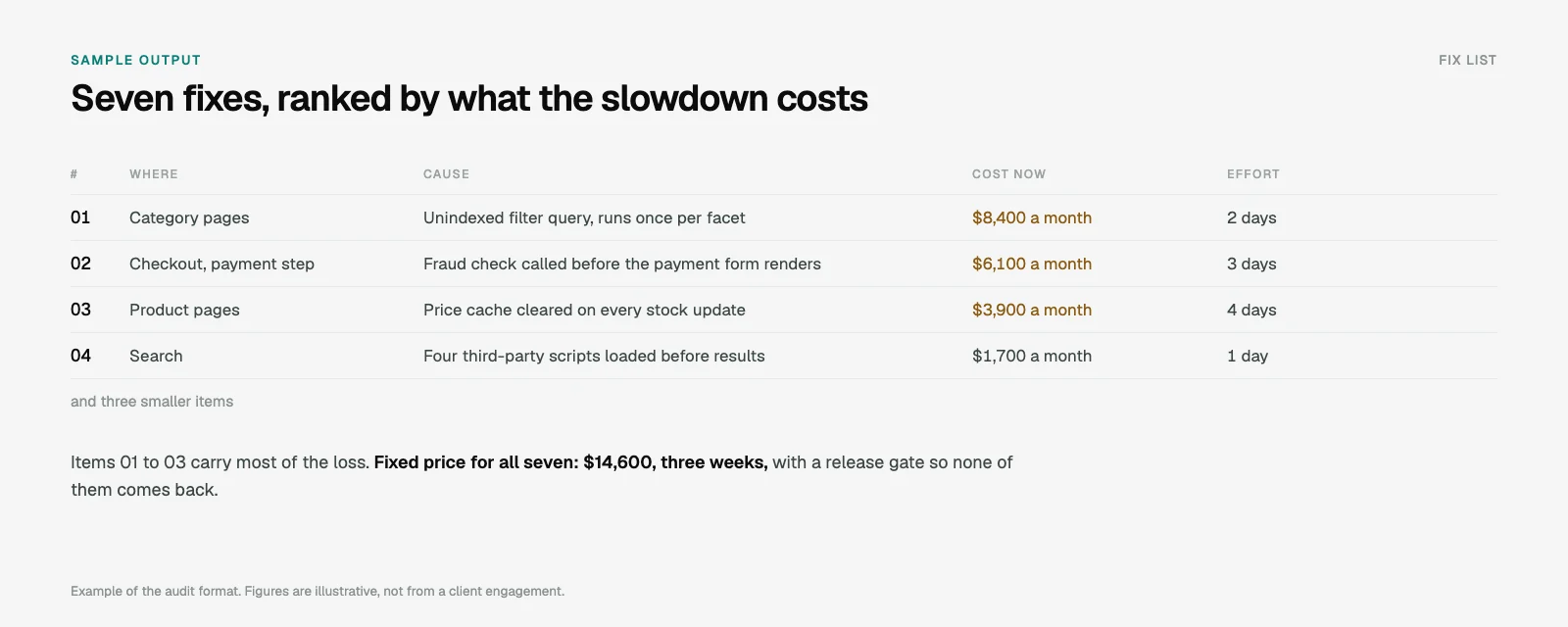
Every item carries where it is, what causes it, what it costs you now and what fixing it takes. The list ends in one price.
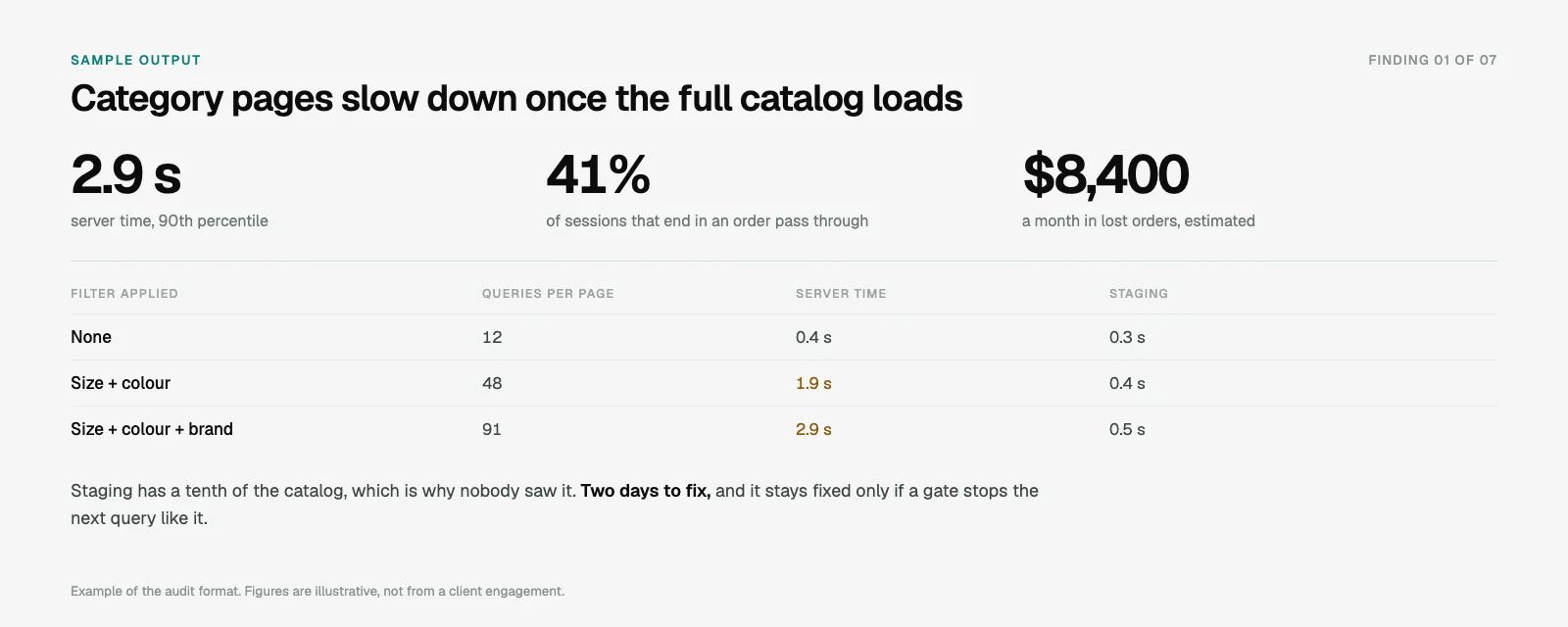
The measurement that matters is the one staging cannot show, because staging does not have your catalog.
Field data from your analytics and Search Console, and five or six revenue templates profiled on your real catalog: category, product, search, cart and checkout.
Every item with what it costs you, what fixing it takes, and where it sits, ranked by what it pays back.
One price for the whole fix, so the next step has a number before it has a contract.
A call where we take your team through the findings and answer what the report does not.
The fix list is written to be handed to any team. We would like to do the fix, and it does not have to be us.
Field data, and the revenue templates profiled on your real catalog.
The server side, the cache and the checkout paths.
The fix list, the price for the fix, and the walkthrough with your team.
$2,250, fixed. No hourly billing. If you go ahead with the fix, from $7,500, the full fee credits toward it within 60 days of delivery. If the audit shows the platform is the constraint, half the fee, $1,125, credits toward the eCommerce Architecture Review instead.
Half goes into the review because the two overlap only in part. The review still reads the whole platform and its integrations; only the speed part is already done. Below $7,500 there is no credit on the fix.
Three endings, and we commit to all three.
A fixed price for the fix, ranked by what it pays back. The list works with any team. We would like it to be us, and it does not have to be.
The platform itself is the constraint. We say so, and half the audit fee goes toward the eCommerce Architecture Review.
The store is slower than it could be, and fixing it would not pay back yet. We say that too, and you keep the measurements.
You are buying a number and a decision. What you do with them is yours.
Performance stabilised as a system outcomeRegressions on high-traffic templates caught by gates before they reach all users.Read the caseCheckout stabilised under loadCheckout fixed while revenue kept running through it.Read the caseThese are delivery cases, not audits. The audit is new and we will not pretend otherwise. What they show is that the measurements and the price come from people who have done the fixing.
The questions teams ask before the first call. If yours is not here, ask it on the call.