Services
Blockchain
Services
Blockchain
Lazy Ants · Web3 · Fixed-price review

Web3 Architecture ReviewTwo weeks to find the decisions that stop being reversible.

The Web3 Architecture Review costs $4,850 and ends with the list of decisions you can still change.
$4,850
fixed price
2 weeks
from day zero
3
possible endings, including moving the date

What you walk away with

Four documents come out of the two weeks. What we look at and what you receive are the same list, read from opposite ends. You keep all four. Even if you never speak to us again.

What each document is built from:

Risk register

Every assumption we could break, with severity and the constraint that must hold: trust boundaries between smart contracts, who holds admin keys and upgrade rights, and where the economic mechanism fails under stress.

  • Trust assumptions
  • Admin keys and upgrade rights
  • Economic and mechanism design

Intervention map

Who can act when something goes wrong, through which path, and how fast: pause authority, the multisig or timelock behind it, upgrade and migration routes, and what the protocol does in degraded mode.

  • Pause authority and escalation
  • Upgrade and migration routes
  • Monitoring and degraded mode

Dependency exposure list

The outside systems whose failure becomes yours, and your cap on each: oracles and price feeds, bridges and cross-chain integrations, keepers, relayers and the sequencer.

  • Oracles and external data
  • Bridges and protocol integrations
  • Keepers, relayers and sequencers

Open questions before launch

Decisions still reversible today, each with the point after which it is not: invariants the spec leaves unstated, parameters and thresholds nobody has justified, and the mainnet deployment sequence.

  • Invariants and specification
  • Parameters, caps and thresholds
  • Deployment and launch sequence

This is what the report looks like

Two pages out of the four documents. The structure is what every review produces; the figures here are illustrative.

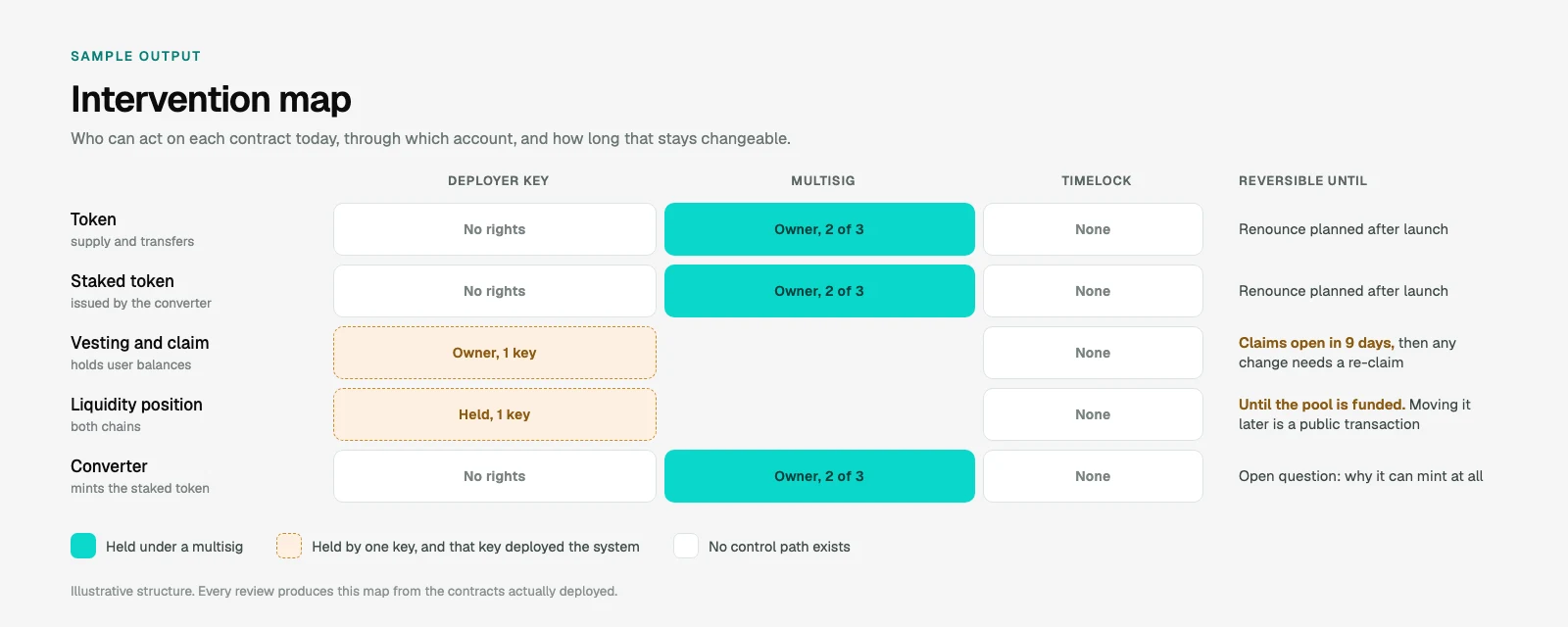
Page 1 · Who can act when something goes wrong
Intervention map showing, for each contract, whether control sits with the deploying key, a multisig or a timelock, and how long each arrangement stays changeable

The gap is the point. Two smart contracts, the one holding user balances and the one holding liquidity, are controlled by the same key that deployed them, and the right-hand column says how long that stays fixable.

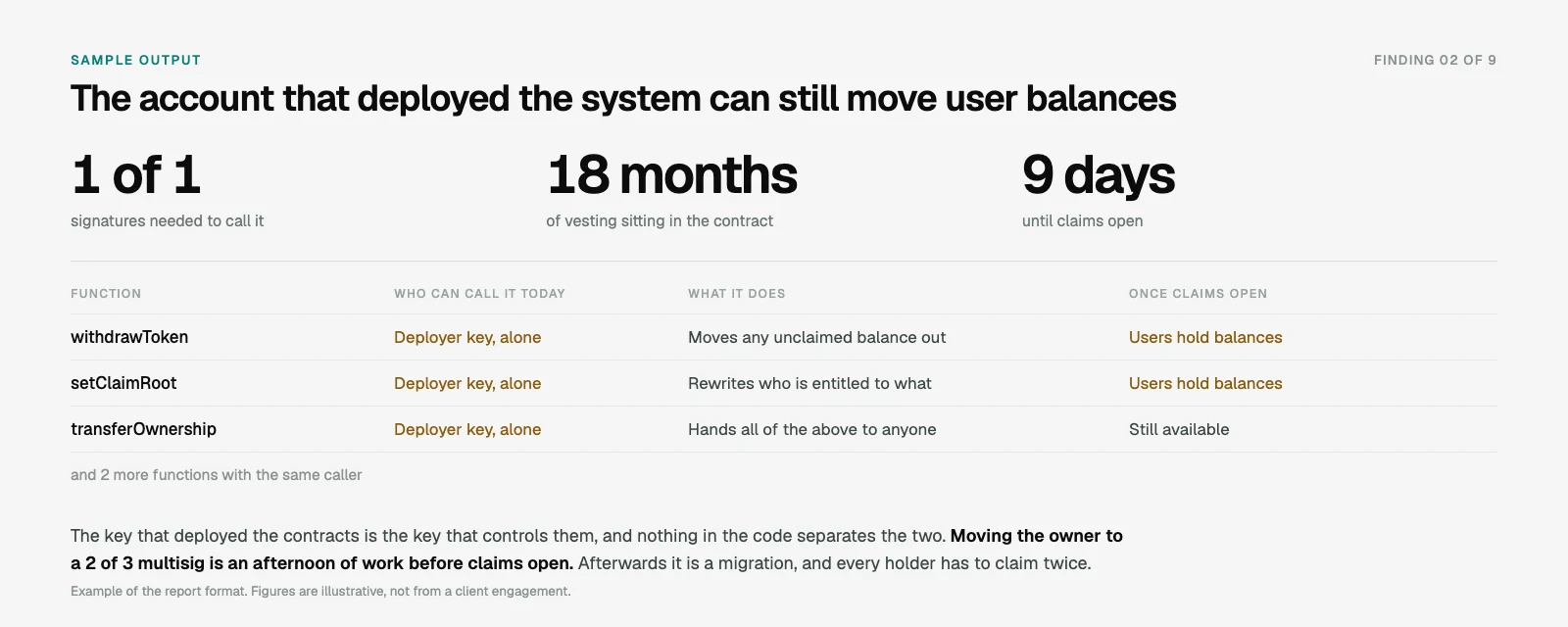
Page 2 · One finding
A page from the review report: a finding showing that the deploying account can still move user balances, the functions it can call, and what changes once claims open

Every finding carries what it is, how far it reaches, what it takes to fix, and the date after which fixing it stops being cheap.

Fixed-price review

Web3 Architecture Review

$4,850Fixed price
2 weeksFrom day zero
Credited in fullAgainst any work from $15,000, within 90 days.

You keep

  • Risk register
  • Intervention map
  • Dependency exposure list
  • Open questions before launch

Fixed-price review

Web3 Architecture Review

$4,850Fixed price
2 weeksFrom day zero
Credited in fullAgainst any work from $15,000, within 90 days.

You keep

  • Risk register
  • Intervention map
  • Dependency exposure list
  • Open questions before launch

One of the two weeks, nobody talks to you

That is deliberate. Days three to seven are one engineer alone with the repo, the deploy scripts, and whatever documentation stopped being true a few months ago. Interrupting that makes the review worse. Your team has better things to do anyway.

  1. IntakeDays 1–2

    One call. Send the repo, any diagrams, and the spec even if it is half-written. What we mostly need to know is which decisions are already frozen.

  2. MappingDays 3–7

    The reviewer works through the system alone and builds the risk register and the dependency list.

  3. Review sessionDay 8

    Two hours with your engineers, while findings can still be argued with.

  4. Written deliveryDays 9–10

    Four documents, walked through once, with open questions ranked by deadline.

5+ years
CPAY in production
2.5 years
Confidential DEX on Base, zero emergency stops
0
Funds lost in the Panther Wallet custody migration

Two weeks, from day zero

Day zero is the day access is granted and one person on your side is named as the owner. It is not the day the invoice is signed.

What day zero requires

  • Read access to the smart contracts
  • Whatever diagrams or specs exist, even half-written
  • One hour for the intake call
  • One named person who can answer a question within a working day

Missing documentation is not a blocker. Its absence is itself one of the things we report on.

Who runs the review

One engineer reads the system and signs the findings. The other two exist so that the reading is the only thing he has to do: the first call decides whether the review fits you at all, and everything around the read — access, a second pass over the findings, the walkthrough and the next steps — is someone else's job.
Alex Harmatenko
CTO · Leads the reviewAlex
Harmatenko
The read
Spends days three to seven alone with the contracts, the deploy scripts and whatever documentation stopped being true. Writes the register and defends it on the call.
Day zero, the second opinion, and what follows
Sets up access and the named owner on your side, challenges every finding before it reaches you, runs the walkthrough, and scopes whatever the open questions point to.
Whether it fits at all
Takes the first call. Tells you whether the review earns its price at your stage, and says so plainly when it does not.

When a pre-audit architecture review earns its price

Something is built, and some decisions are already frozen. Too early and there is nothing to bite on. Too late and every finding needs a governance vote instead of a pull request.

Signals the review is worth booking now:

  • Smart contracts exist and part of the design is already settled
  • A launch or TGE date is close enough to be real
  • An audit is booked and you would rather pay for fewer findings
  • External stakeholders will ask how the system fails

Signals it is the wrong step today:

  • Nothing is frozen, the design still changes weekly
  • The need is capacity, not an outside opinion
  • Smart contracts are live and the decisions in question cannot move
  • A full audit is what you actually want. We prepare for those, we do not run them

How it ends

Three endings, and we commit to all three.

Launch as planned

The architecture holds. The register becomes the list of constraints that have to stay true after you ship, and the open questions have answers you chose rather than inherited.

Change these first

A specific set of decisions to reverse before deployment, each with the date after which reversing it stops being an option. Usually a shorter list than teams expect, and usually not the part they were worried about.

Move the date

Sometimes what has to change does not fit in the window you have. Moving a launch costs a few weeks. Launching into a decision you cannot take back costs the rest of the product's life. We say so, and the review has paid for itself in the saying.

You are buying the list of decisions you can still change. What you do with it is yours.

Questions we get before booking

If yours is not here, ask on the first call. We would rather talk you out of this than sell you a review that does not fit.

How much does it cost?
$4,850, fixed, invoiced once. If any work follows, from $15,000, the full fee credits toward it within 90 days of delivery. The credit does not depend on what we find.
Is this a security audit?
No. We prepare systems for audit, we do not perform them. There is no formal verification and no line-by-line proof. What you get is the list of things worth fixing before a smart contract auditor bills you to find them.
We already have an auditor booked. Is this redundant?
No, it runs before them. Auditors assess the code you hand over; this review questions the decisions underneath it. That is the pre-audit step: fixing those first means fewer findings to pay for and fewer re-audits after changes.
Do you fix what you find?
Not during the two weeks. The review stays a review. The register is written so any team can act on it, including yours. If you want us to do the work, that is a separate engagement and the review fee is credited against it.
How soon can you start?
Start dates are booked in order of request. Tell us your launch or audit date on the first call and we will say honestly whether two weeks still fits before it.

Request the review

Send whatever exists today: contracts, a diagram, a half-written spec. If the review would not earn its price for you right now, we will say so on the first call.
Web3 Architecture Review in Two Weeks | Lazy Ants