The process
Runs the interviews, maps how the work actually happens, takes the baseline, and sets the success criteria and the roles.
Not with a failure. With a pilot that worked and a production launch that never got scheduled.
Most AI projects do not fail on the model. They meet a process nobody owns, a success metric nobody agreed on, and approval rules that live in three people’s heads. This review looks at the process before it looks at the technology. Readiness here means the process, the data it needs and the people who own it, not the model. Sometimes the answer is that no AI should touch it yet. We say that too.
A pilot worked and never reached production, and nobody can say precisely why.
Several processes look like candidates, and there is no agreed way to choose between them.
Someone above you has asked for AI without saying where, and the answer has to be defensible.
A vendor has proposed something, and you want a read from someone who is not selling that build.
The process you have in mind is done differently by each team, and nobody has written it down.
If none of these describe your situation, this review is early.
Almost everything that stops them is organisational. The technology is rarely the hard part.
After launch, someone has to decide what happens when the system gets it wrong. If that person is not named before you start, they do not appear afterwards.
If nobody measured what the process costs today, in hours, in errors, in delay, there is no way to show later that anything improved. Projects that cannot prove improvement get quietly defunded.
A system can only be given permissions that exist as rules. “Check with Marina if it is a large order” is not a rule until someone says what large means.
Two departments do the same job differently, and the version that gets automated turns out to be the one nobody actually uses.
The information it needs sits across three systems, and there is no read path into any of them.
None of these show up in a demo. All of them show up in month two.
Two pages out of about twenty. Structure is what every review produces; the figures here are illustrative.
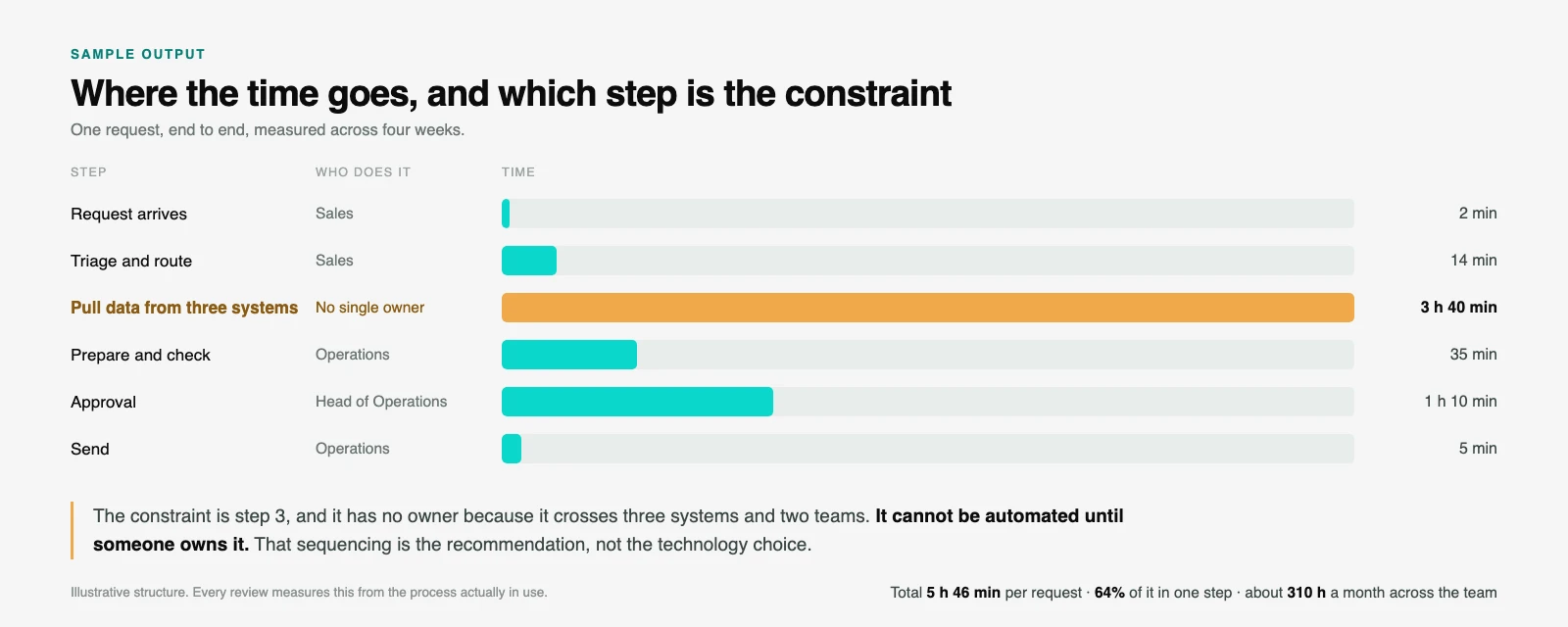
Every step measured, so the constraint is a number rather than an opinion. The step that costs most is usually the one nobody owns, and that is what decides the order of work.
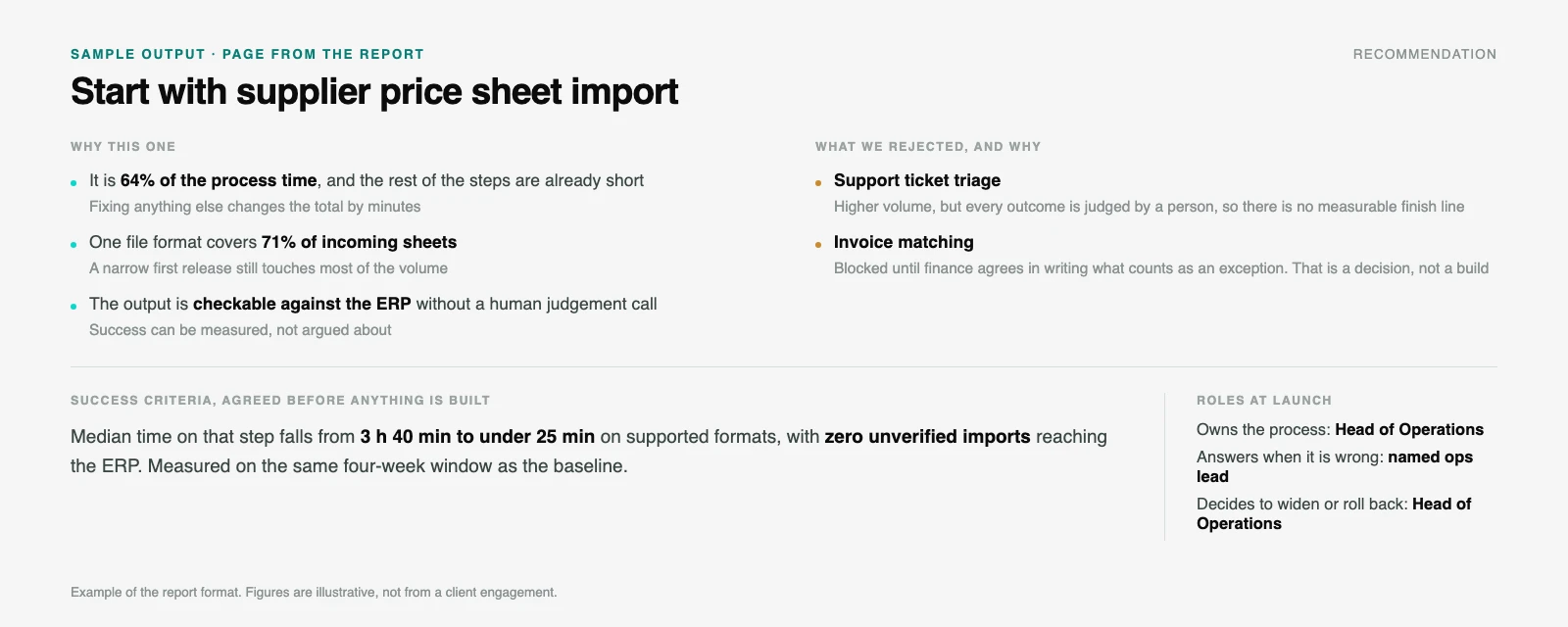
What we recommend, what we rejected, and why. The rejected options matter as much as the chosen one: they are what you will be asked about internally.
The process as it actually runs, not the version in the documentation. Built from interviews with the people who do the work, including the workarounds they never mention in meetings.
What the process costs you now, in hours, headcount, error rate and delay. This is the number any later return is measured against, and what makes a claim of improvement checkable.
The recommended first use case, with the reasoning, and what was considered and rejected. The rejected options matter: they are what you will be asked about internally.
What “working” means, as numbers, agreed before anything is built, so the result is not a matter of opinion.
Who owns the process at launch, who answers when the system is wrong, and who decides to widen or roll back.
The governance of the first release: what data the system may read, what it may act on by itself, and where a person approves. Plus where your data may and may not go.
An implementation roadmap with a budget and timeline range for the first release.
The report is written to be forwarded. Your finance lead should be able to read it without you translating it first.
Access to people matters more here than access to systems. Most of what we need is not in a database. It is in the heads of the people doing the work, and it takes their calendars, which is why this review runs three weeks rather than two.
Partner program
 Partner Network
Lazy Ants is part of the Claude Partner Network, Anthropic's partner program for organizations helping businesses adopt Claude.
$4,500, fixed. No hourly billing and no scope negotiation after the fact.
If you go ahead with the work we recommend
$4,500
credits in full toward that project, on any project from $12,000.
Not a percentage · No cap
The credit does not depend on what we recommend. We have no financial reason to point you at a larger build, which is the point of paying for the review rather than asking a vendor for a free opinion.
Three endings, and we commit to all three.
The process, the success criteria, the roles, the boundaries, and a scope with a range. That package works with any vendor. We would like it to be us, and it does not have to be.
Often the process a team arrives with is not the best first step. Another one is smaller, measurable sooner, and proves the case internally at lower risk.
Sometimes the bottleneck is not something a model solves. Automating undefined work makes the mess faster, whatever the AI automation vendor says. We say so, and you have saved a year of building the wrong thing.
You are buying a decision. What you do with it is yours.
 Thin slice to productionOne operational workflow narrowed to a first production slice, with acceptance criteria and a verification step before anything reached the ERP. This is the shape of project the review leads into.Read the case
 RAG in productionVector search and candidate filtering turning internal data into a stable planning workflow, with cost and latency held under real load.Read the caseObservability and incident responseOur own production system. What happens after launch, when live behaviour drifts: the signals worth watching, and who answers when quality moves.Read the caseAI summaries inside the ERPSummary generation turned into a live ERP workflow with saved state, freshness checks and admin controls. AI working inside an existing system of record, not beside it.Read the case
If yours is not here, ask on the first call. We would rather talk you out of this than sell you a review that does not fit.