

- Who owns the vendor? A lab's own venture will reasonably recommend that lab's model, and being the one embedded creates lock-in. We are part of the Claude Partner Network, so ask us the same.
Forward-Deployed Engineers: What the DeployCo Wave Means for Your Team
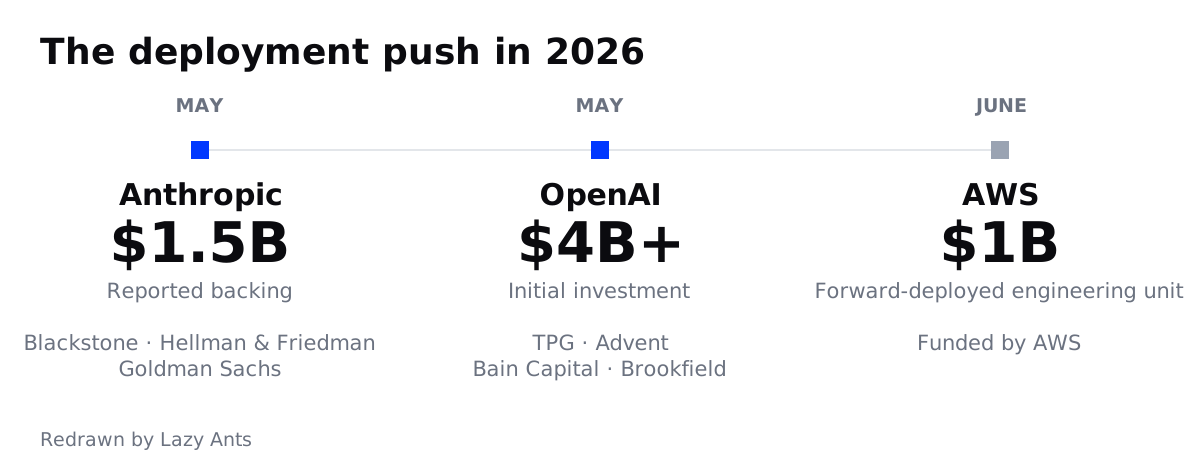
Anthropic, OpenAI and AWS put more than $6 billion behind one idea in 2026: engineers who work inside the customer's company.
Here is what a DeployCo is, what you actually buy when you hire one, and how the same format works for AI, eCommerce and Web3 teams.
Three big names backed one idea
Between May and July, the labs and the largest cloud put real money behind forward-deployed engineers.
Anthropic announced a $1.5 billion AI services firm with Blackstone, Hellman & Friedman and Goldman Sachs. It launched as Ode and was built on the acquisition of Fractional AI. OpenAI raised more than $4 billion for a deployment company led by TPG, bought Tomoro, and started with over 100 forward-deployed engineers. AWS committed $1 billion to its own forward-deployed engineering unit.
What a DeployCo does
A DeployCo is a services company that embeds engineers inside a customer and gets AI agents working in real workflows.
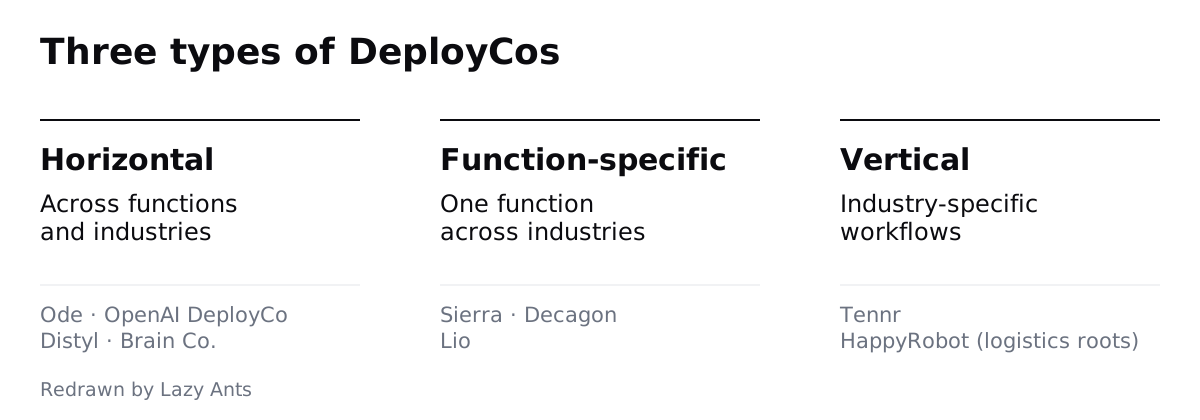
The people who do this carry titles like forward-deployed engineer, agent deployment or deployment strategist. There are three types: horizontal ones that work across functions and industries, function-specific ones, and vertical ones tied to a single industry.
The usual playbook
01Embed with the customer and pick a few high-value workflows that are bounded and can be checked
02Build a harness that connects the model to the company's data and systems
03Write evals, iterate, and deploy once quality clears an agreed bar
04Where possible, add a learning loop so the agent keeps improving in production
Consultancies already sell this
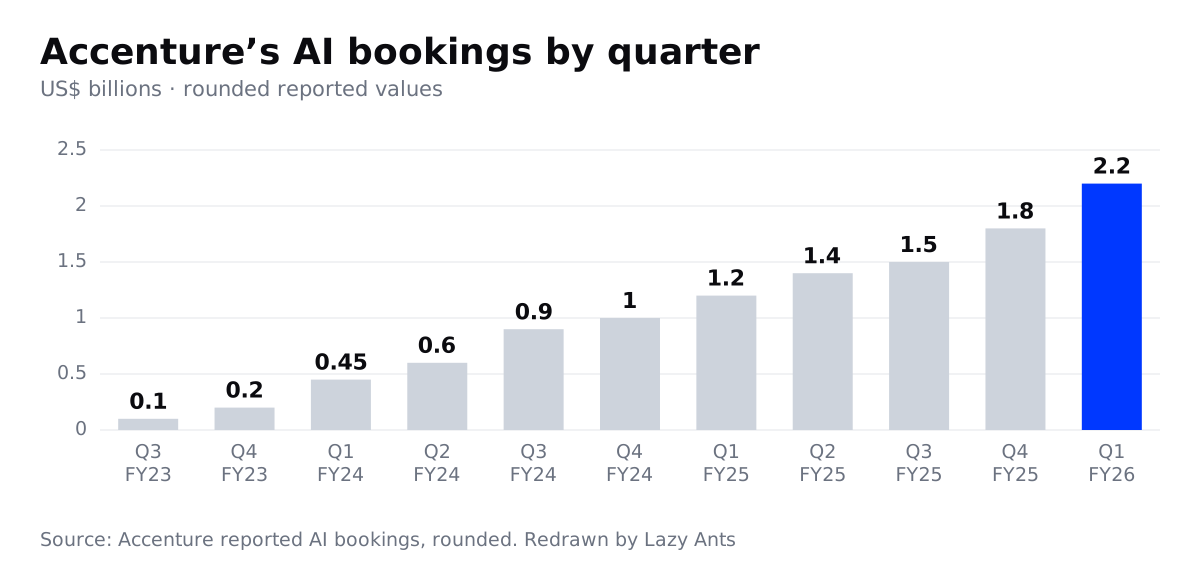
Accenture has booked about $11.5 billion of generative AI work over the last three years.
Palantir has worked this way for more than a decade, and Accenture's quarterly AI bookings keep rising. What changed in 2026 is that the model makers joined them.
Why it is happening now
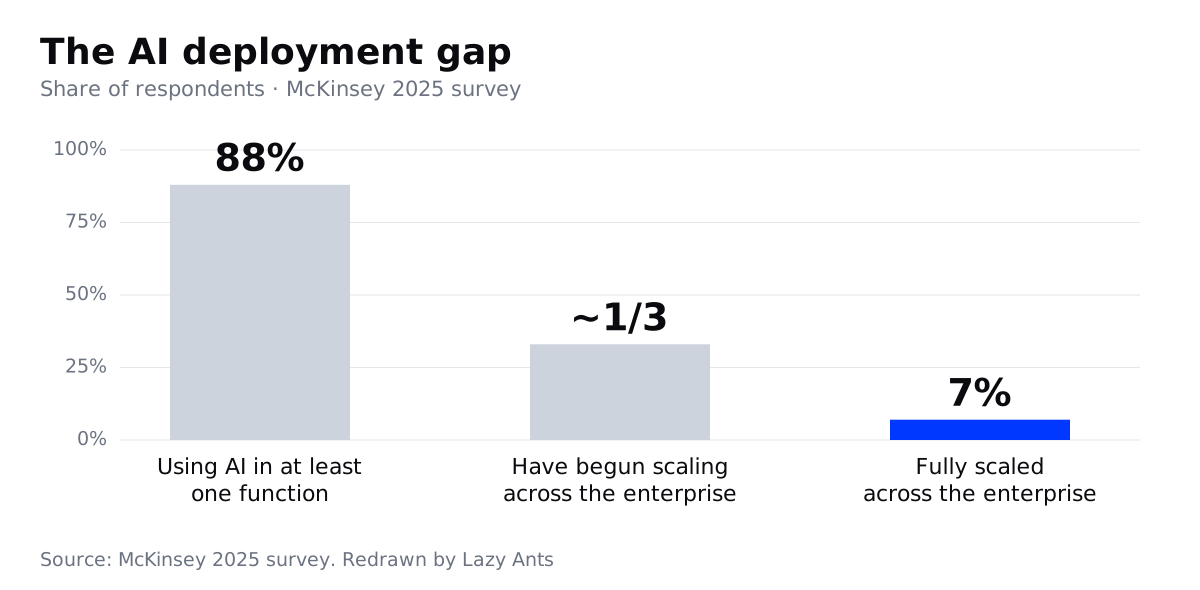
Models can already do more than most companies ask of them.
OpenAI's GDPval benchmark found models beating experts on over half of the tested tasks, while most organizations are far from using AI at that level. Adoption stalls on things a model cannot supply: access to systems, a redesigned workflow, agreement between teams, and a person who answers for the result. No single function owns that work. An engineer who sits inside the company can take it on.
Yes, this is renting engineers
Remove the branding and a forward-deployed engineer is a senior engineer you rent for a defined job, working inside your systems.
Demand for consultants is strong too, they are simply branded differently. We see nothing wrong with that. Renting a strong engineer for a bounded job is an old and sensible way to buy. What differs between vendors is what comes attached to the engineer, and four questions cover most of it.
Four questions to ask any vendor
- What is the first workflow, and what counts as done? Small, with one owner and acceptance criteria written before building starts.
- What stays when the engineer leaves? Code in your repository, runbooks, evals and an access list your team can read. If the harness lives on the vendor's platform, you leave without it.
- Can you stop? A review that cannot end in "do not build this" is a sales step. Our AI Readiness Review has three possible answers, and "not yet" is one.
What a small first workflow looks like
For Get Energy we narrowed the first AI release to one supported supplier file format, one import flow and one verification step before anything is committed.
New formats were added one at a time. The result was up to 75% less manual preparation per import.

Same format in AI, eCommerce and Web3
The format is older than AI agents, and we run it in all three directions.
It fits any team that has a live system, a decision that is hard to undo, and nobody with the time to own the next step. Our case studies show what that looks like in production.
How we run it
A fixed-price review first, then a fixed-scope slice, then support.
The first two steps have a price and acceptance criteria before work starts.
Fixed-price review
- AI, eCommerce or Web3. Price and date are agreed before work starts.
Fixed-scope slice
- A slice with acceptance criteria and a fixed price.
Support after launch
- An engineer can stay on the system under a support agreement. This is the rented part.
When it is a poor fit
If nobody on your side owns the process, an engineer cannot supply that person.
The review will tell you so. If you need a model demo for a board meeting, a deployment company is the wrong purchase.
See what a first step looks like
You will talk to a senior engineer, not a salesperson.
Share your product context and we will point you to the right next step.
Related articles
RAG Latency and Cost Failure Modes in Production AI Workflows
RAG can look useful in a demo and become slow, expensive, or noisy once real users and real internal data enter the workflow.

AI Code Review Tools vs. Human Review: Where to Draw the Line
AI code review tools catch real bugs and miss real context. See where automated review is enough and where a human still has to look.
Fine-Tuning an LLM: Cost and When It Is Worth It
LLM fine-tuning cost by method and model size, from under $10 with LoRA to $10,000+ for a full fine-tune, and when it beats RAG or on-device.